
Stadium & Airport F&B Strategy Explained
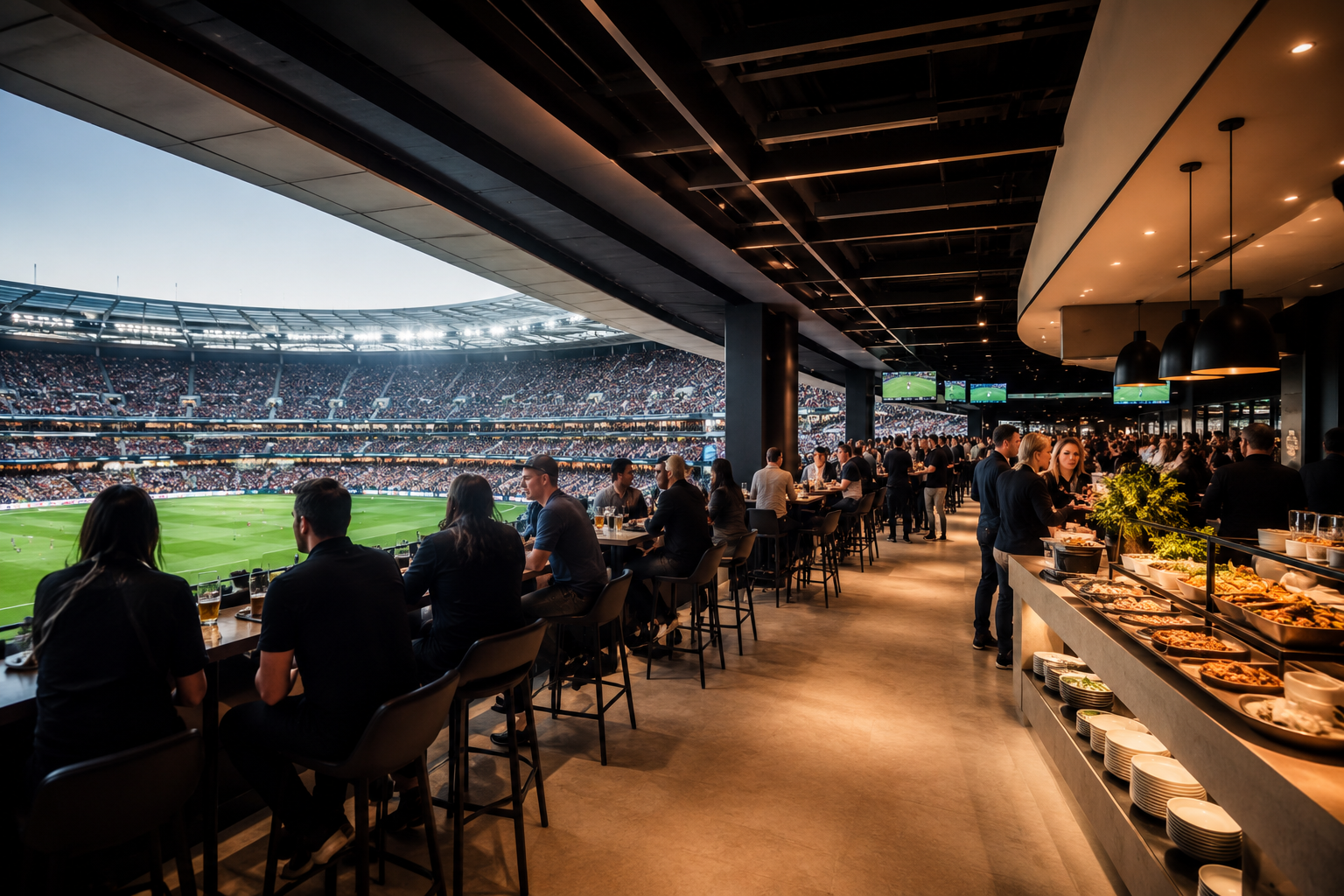
Food and hospitality plays a significant role in how modern stadiums and airports are experienced, remembered and valued. Beyond providing convenience, food and beverage contributes to customer movement, premium experiences, commercial performance and destination identity. Developing an effective stadium F&B strategy begins by understanding how hospitality supports the broader objectives of the asset.
At an airport, you might have several hours to influence how and where passengers spend their time.
Both environments rely heavily on food and hospitality, but they operate according to very different customer behaviours. That's why a successful stadium F&B strategy starts long before operator appointments, lease negotiations or fit out discussions.
The venues that consistently outperform their peers tend to view hospitality as part of the commercial planning process. They understand that food and beverage influences movement, spending, premium experiences and the overall perception of the asset.
Many of these principles sit at the centre of Food & Hospitality Masterplanning and Food & Hospitality Strategy Development, where hospitality is considered alongside customer experience, commercial objectives and long term asset performance.
What Actually Goes Into a Stadium F&B Strategy?
A stadium F&B strategy is fundamentally about understanding how different audiences use the venue.
A family attending a Saturday afternoon AFL match has very different expectations from a corporate guest arriving through a premium hospitality entrance. The family is often looking for convenience, familiarity and value. The corporate guest may spend significantly more before the event starts and remain within hospitality environments throughout the day.
Concert audiences often behave differently again. They tend to arrive earlier, spend more time socialising before performances and place greater emphasis on bars, gathering spaces and premium experiences.
These differences influence everything from tenancy sizing and operator selection through to revenue forecasting and premium hospitality planning.
In our experience, some of the most successful stadium hospitality environments are shaped before leasing discussions begin. At that stage, circulation, servicing, arrival experiences and customer journeys can still influence the broader commercial framework.
That's often where the greatest value is created.
Venue Food and Beverage Master Planning
Venue food and beverage master planning brings together hospitality planning, customer movement and commercial objectives before individual operators are selected. Decisions made during this stage influence where hospitality is located, how visitors move through the venue and how effectively food and beverage supports the broader customer experience.
One of the first questions we ask on major venue projects is simple.
Where are people actually going?
Visitors rarely move through a stadium at random. They follow predictable routes between transport hubs, parking facilities, entry gates, concourses and seating areas.
Understanding those movements can have a significant impact on hospitality performance.
A kiosk positioned along the primary route between a train station and the main concourse may process several times more transactions than an identical operator located outside the dominant customer flow.
The same principle applies to premium hospitality. Lounges, bars and dining spaces typically perform best when they're integrated into arrival experiences and high dwell time environments rather than isolated from core visitor activity.
Projects such as Marvel Stadium demonstrate how hospitality can support the broader venue experience rather than simply servicing event day demand.
Venue F&B Strategy Beyond Event Day Revenue
The most effective venue F&B strategy projects look beyond what happens during a single event.
Increasingly, venue operators are exploring how hospitality can contribute throughout the week. Restaurants, bars, function spaces and premium hospitality environments can create activity beyond match days, concerts and major events.
This approach creates additional revenue opportunities while helping venues remain active destinations throughout the year.
It's also worth recognising that not all revenue is generated equally.
Across many stadium environments, premium hospitality areas account for a disproportionately large share of food and beverage revenue despite representing only a small percentage of total attendance. That's one reason premium experiences often play a central role in hospitality planning.
Food and beverage isn't simply supporting the event. It's contributing directly to the commercial performance of the asset.
Why Airports Require a Different Hospitality Model
Airports operate according to a completely different set of customer behaviours.
Passenger movement is shaped by flight schedules, security screening, gate locations and dwell time. A traveller with a short domestic connection behaves very differently from a passenger waiting several hours for an international departure.
One observation appears consistently across airport projects.
Passengers become more willing to browse, dine and spend once they've cleared security.
Before screening, many travellers remain focused on reaching their gate. Afterwards, their attention shifts towards retail, dining and relaxation. This behavioural change has a direct influence on hospitality planning.
It's one reason experienced airport F&B strategy consultants place so much emphasis on passenger journeys rather than simply tenancy allocation.
Leading airport operators increasingly evaluate hospitality opportunities by terminal zone, recognising that passenger behaviour often differs significantly between domestic, international and transit environments.
According to research published by the International Air Transport Association (IATA), passenger experience remains one of the most influential factors shaping airport satisfaction and spending behaviour.
Creating an Operator Mix That Reflects Customer Demand
Operator selection is often the most visible outcome of hospitality planning, but it should never be the starting point.
The strongest hospitality environments are built around customer behaviour first and operator selection second.
In airports, that often means balancing familiar national brands with operators that help create a sense of place. A traveller arriving in Melbourne, Auckland or Dubai should encounter hospitality experiences that feel connected to the destination.
Within stadium environments, the challenge is different.
High volume concession operators may need to serve thousands of guests within a short half time service window. At the same time, premium lounges and corporate hospitality environments may generate a substantial share of overall food and beverage revenue despite serving far fewer guests.
Experienced stadium food consultants evaluate these requirements together, creating a hospitality mix that aligns with both operational realities and commercial objectives.
This approach shares many similarities with the broader F&B Tenant Mix Strategy for Precincts & Developments, where customer demand and commercial outcomes are considered together rather than in isolation.
Lessons from Major Airport and Stadium Projects
Future Food has worked across a range of airport, stadium and destination projects including Auckland Airport, Gold Coast Airport, Marvel Stadium and Stadium Australia.
While every project is different, the strongest outcomes tend to share several characteristics.
Hospitality planning starts early.
Customer behaviour is understood before tenancy decisions are made.
Food and beverage is considered alongside movement patterns, commercial objectives and destination positioning.
Most importantly, hospitality is viewed as part of the customer journey rather than a standalone operational function.
The result is a more connected experience for visitors and a clearer commercial framework for asset owners and operators.
Why Early Planning Continues to Deliver Better Outcomes
Once circulation routes, tenancy footprints and servicing requirements have been locked into a project, flexibility becomes limited.
That's why hospitality planning is most effective when it occurs alongside broader discussions around design, operations and customer experience.
Whether the asset is a stadium, airport, mixed use development or major public destination, early planning creates greater alignment between customer expectations, operator requirements and commercial objectives.
It's a principle that sits behind many successful Food Strategy for Urban Precincts & Districts projects and continues to influence how leading destinations approach hospitality today.
Planning Your Next Stadium or Airport Hospitality Strategy
Whether you're developing a new venue, expanding an airport terminal or reviewing an existing hospitality offer, a well considered stadium F&B strategy can influence far more than food sales.
Future Food works with developers, venue operators, airports and major asset owners to develop hospitality strategies, masterplans, feasibility studies and operator procurement programs that align with customer expectations and commercial goals.
If you're exploring a stadium F&B strategy, reviewing a broader venue F&B strategy, or looking for experienced airport F&B strategy consultants, our team can help create a hospitality framework tailored to your asset, audience and long term objectives.
Frequently Asked Questions
What is a stadium F&B strategy?
A stadium F&B strategy is a commercial plan that determines how food and beverage supports the overall performance of a venue. It considers customer behaviour, operator mix, hospitality locations, circulation, premium experiences and long term revenue opportunities rather than focusing only on individual food outlets.
How is airport hospitality planning different from stadium planning?
Airport hospitality is shaped by passenger movements, security screening, dwell time and flight schedules. Stadium hospitality is driven by event programming, crowd movement and concentrated service periods such as pre event arrivals and half time. While the operating models differ, both require hospitality planning that aligns with customer behaviour and commercial objectives.
When should food and beverage planning begin on a project?
Food and beverage planning delivers the greatest value during the early planning and masterplanning stages. This allows decisions around tenancy locations, customer movement, servicing infrastructure and hospitality experiences to support the broader commercial framework before leasing begins.
Why work with stadium food consultants?
Experienced stadium food consultants bring specialist knowledge of venue planning, operator procurement, customer behaviour and commercial modelling. Their role is to help developers and venue operators create hospitality environments that support visitor experience while improving long term commercial performance.