
F&B Operator Sourcing for Major Developments and Precincts
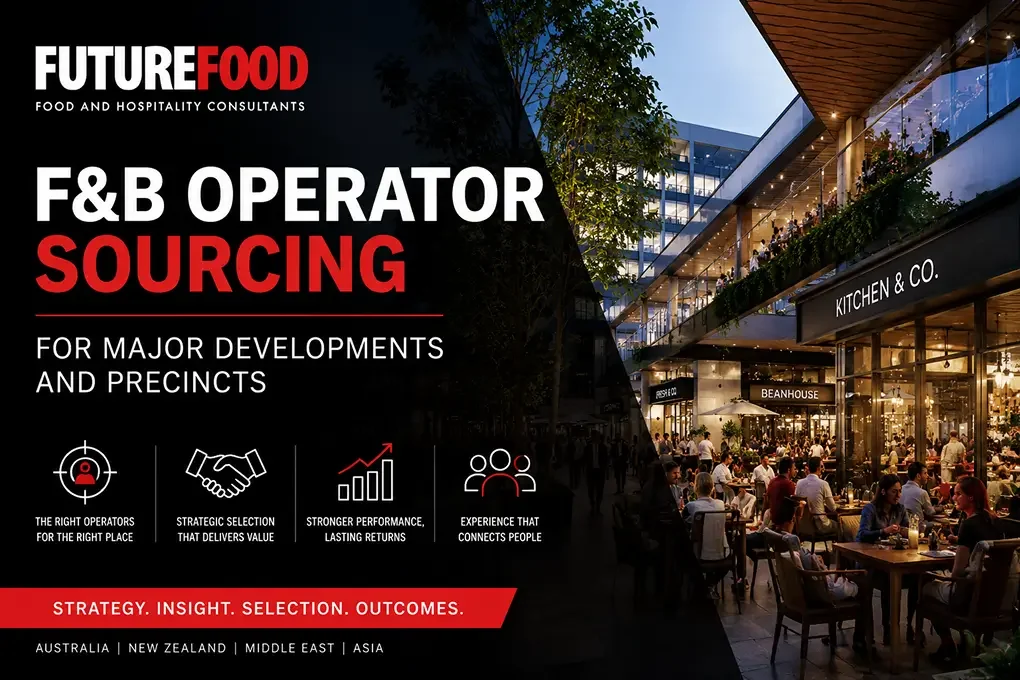
In major developments, hospitality operators do more than occupy space. They influence how people move through a destination, where they spend time, how often they return and how the asset is perceived by customers, tenants and stakeholders.
That influence can last for years.
Whether it is a shopping centre, airport, university campus, cultural venue or mixed use precinct, the operators selected today will often shape customer experience and commercial outcomes long after the project opens. For that reason, F&B operator sourcing is one of the most influential parts of a food and hospitality strategy.
The most successful projects treat operator selection as an extension of the broader vision for the asset. The focus is not simply on leasing space. It is on identifying operators that align with customer demand, support the desired experience and contribute to the long term performance of the destination.
For organisations exploring a broader food and hospitality strategy, this work should sit alongside a clearly defined Food & Hospitality Strategy Development page.
Why F&B Operator Sourcing Should Start Early
The strongest operator outcomes are usually influenced well before a tenancy is marketed.
During masterplanning and concept development, there is still an opportunity to shape tenancy sizes, servicing requirements, loading access, waste management, exhaust provisions and customer movement pathways. These decisions have a direct impact on the types of operators that can be accommodated later.
Across major developments, operators assess opportunities based on far more than customer numbers. Visibility, access, tenancy configuration, outdoor seating opportunities and proximity to complementary uses often play an equally important role in their decision making.
This is one reason operator engagement can add value during the planning phase.
A mixed use development considering a food hall will require different infrastructure and tenancy planning to a precinct centred around destination dining. An airport terminal designed around convenience and throughput creates different operator requirements to a university campus focused on affordability and repeat visitation.
For organisations planning mixed use environments, Future Food's guide to F&B planning for mixed use developments provides additional insight.
Understanding those requirements early helps create a more informed leasing and procurement strategy.
Looking Beyond Brand Recognition
Well known operators can bring credibility to a project. They can create interest from customers, support leasing momentum and help establish confidence in a new destination.
However, brand recognition is rarely the only consideration.
Across procurement programs, the operators best suited to a project are not always the largest brands in the market. They are the operators whose business model, customer offer and operational capability align most closely with the objectives of the asset.
A waterfront precinct seeking to establish itself as a dining destination may prioritise operators with a proven ability to create memorable customer experiences. A transport hub may place greater emphasis on speed of service, throughput and operational efficiency. A university campus may focus more heavily on value, convenience and the ability to serve customers consistently across multiple dayparts.
For further reading, see University Campus Food Strategy Explained.
The context matters.
Successful F&B operator sourcing requires an understanding of what customers expect from the destination and how hospitality can contribute to that experience.
Assessing Operator Suitability in Practice
Operator evaluation is often more detailed than many stakeholders expect.
During the assessment process, operators are typically reviewed across a range of commercial and operational criteria. This includes their experience, financial capacity, concept relevance, staffing model, supply chain capability and ability to deliver within the physical constraints of the site.
In practice, some concepts present exceptionally well but require servicing arrangements or back of house infrastructure that may not align with the proposed tenancy. Others may have a compelling customer offer but operate best in environments with very different trading patterns.
These considerations become particularly important in complex assets.
For example, operators accustomed to suburban retail environments may require a different operating model when moving into airports or transport hubs where peak demand periods, customer expectations and staffing requirements can vary significantly.
Similarly, concepts that perform well within office precincts may need adaptation before being introduced into university environments where pricing expectations and purchasing behaviour are different.
The goal is not simply to identify operators that are interested in the opportunity. It is to identify operators that are likely to perform well within the specific conditions of the asset.
Creating a Hospitality Mix That Supports the Asset
Individual operators matter. The overall mix matters just as much.
One of the most common objectives in operator sourcing hospitality is creating a hospitality ecosystem where different operators perform different roles throughout the customer journey.
Within a shopping centre, an all day café may support morning visitation and informal meetings. Quick service operators may cater to lunchtime demand. Casual dining venues may encourage customers to stay longer into the evening.
Within a mixed use precinct, hospitality can help connect residential, commercial, retail and public realm uses throughout the day. In these environments, operators positioned along key movement corridors often contribute more to precinct activity than venues located in isolated pockets, regardless of their size.
The most effective hospitality strategies consider how operators complement one another rather than viewing each tenancy in isolation.
This creates a more cohesive customer experience while helping distribute activity across different trading periods.
Check for more on creating an effective F&B tenant mix.
Check for broader thinking around food strategy for urban precincts and districts.
Managing F&B Operator Procurement
A well structured F&B operator procurement process helps attract operators that genuinely align with the opportunity.
Quality operators want clarity. They want to understand who the customer is, how the asset will function, what adjacent uses exist, how the tenancy is configured and what the long term vision for the destination looks like.
This is why procurement documentation and market engagement are important.
For larger developments, F&B operator procurement may involve market mapping, targeted operator outreach, Expressions of Interest, Requests for Tender, operator interviews and commercial evaluation.
Each stage helps build a clearer understanding of market interest while providing stakeholders with confidence in the selection process.
Importantly, procurement should evaluate more than rental outcomes.
The operator that offers the highest rent is not always the operator most likely to contribute to customer satisfaction, destination appeal or long term trading performance.
Successful procurement balances commercial objectives with customer experience, operational practicality and the strategic goals of the asset.
For a deeper look at hospitality procurement processes, read: Rethinking Food & Hospitality Procurement: Why the EOI Approach Delivers Better Results
The International Council of Shopping Centers also provides useful industry research covering retail, hospitality and mixed use destinations globally.
The Role of Hospitality Tender Consultants
For many developments, operator procurement is a specialist exercise.
Hospitality tender consultants provide an independent perspective while helping project teams navigate a highly competitive and constantly evolving market.
They bring insight into operator performance, emerging concepts, customer trends, and market demand. They also understand the operational realities that influence hospitality success after opening.
Across major projects, independent advisors often act as a bridge between landlords, developers, project teams, and operators. Each group approaches the opportunity from a different perspective.
Developers may focus on commercial returns and delivery timelines. Operators may focus on kitchen functionality, staffing efficiency, and customer flow. Asset owners may be considering long-term performance and stakeholder expectations.
Bringing these perspectives together helps support more informed decision-making throughout the procurement process.
Explore Future Food's EOI & Tendering Management services.
Hospitality procurement for major developments is rarely a standard leasing exercise. Shopping centres, airports, universities, mixed-use precincts, cultural destinations and civic assets all have different commercial objectives, customer expectations, and operational requirements. Selecting operators who align with those objectives requires more than issuing an Expression of Interest.
This is where hospitality tender consultants add value.
Independent consultants bring market knowledge that complements the expertise of developers, landlords, and project teams. They understand operator capability, emerging concepts, commercial trends, and the practical requirements that influence performance once venues begin trading.,
Their role typically begins well before tender documents are released. Market testing helps determine which operators are most suited to the opportunity, how the offer should be positioned, and what level of market interest can reasonably be expected. Those insights often shape procurement documentation, evaluation criteria, and the overall market approach.
Throughout the tender process, hospitality tender consultants provide an objective assessment framework that considers commercial capability, operational suitability, customer alignment, and long-term asset performance. Financial strength is one consideration, but it sits alongside concept quality, operational experience, staffing capability, brand alignment, and the ability to deliver consistently within the specific conditions of the development.
For complex projects involving multiple stakeholders, an independent advisor also helps align competing priorities. Developers may focus on delivery programmes and investment outcomes. Asset owners may prioritise long-term precinct performance. Operators assess functionality, servicing, staffing,, and trading potential. A structured evaluation process creates transparency across each of these perspectives while supporting confident procurement decisions.
The outcome is not simply the appointment of an operator. It is the selection of hospitality partners that contributes to customer experience, leasing confidence, and the commercial positioning of the asset over many years.
Planning Beyond Operator Selection
The work does not end once an operator is appointed.
The transition from procurement to opening is where planning decisions begin to influence day-to-day operations. Fitout delivery, onboarding, marketing, operational readiness,, and launch planning all contribute to how successfully a venue enters the market.
Across major assets, operators that receive clear onboarding, realistic opening timelines, and strong stakeholder support are often better positioned to establish momentum during the early stages of trade.
This is particularly relevant in precincts where multiple venues open within a short period, and customer expectations are still being established.
Hospitality performs best when operators and asset owners work towards shared objectives. The appointment process is the beginning of that relationship, not the end.
Identifying Operators That Align with the Vision
Effective F&B operator sourcing is about finding the right fit between operator, customer, and place.
It requires an understanding of market demand, customer behaviour, commercial objectives, and operational realities. When these elements are aligned, hospitality becomes an active contributor to the performance, appeal, and identity of the asset.
Future Food works with developers, landlords, precinct owners, airports, universities, cultural institutions, and major asset owners to deliver operator sourcing hospitality programs, F&B operator procurement processes, and independent tender management services.
You can learn more about Future Food's experience sourcing and assessing hospitality operators.
If you are planning a new development, reviewing an existing hospitality offer, or preparing to take opportunities to market, our team can help identify operators that align with your vision and commercial objectives.
Contact the team to discuss your project.