

Every university property team has, at some point, sat in a room and asked a version of the same question: how much free or subsidised food is too much? It is rarely put so bluntly in a board paper, but it sits underneath almost every conversation about student wellbeing, campus redevelopment and retail strategy. Get the balance wrong in one direction and students go hungry on a campus that talks endlessly about wellbeing. Get it wrong in the other direction and the retail tenants who make campus life feel normal, who sell the coffee, the noodles, the after-lecture snack, start quietly packing up.
At Future Food, we often sit at the intersection of these two conversations. We work with universities on precinct strategy and with the operators who lease space inside those precincts, and we have learned that the tension between food relief and commercial performance is not really a tension at all if it is planned properly. It is a design problem, and increasingly a governance problem… One that needs sponsorship from the top of the university as much as it needs a good floor plan. Solve both, and the economics tend to follow.
The Pressure Is Real, and It Isn't Going Away
Food insecurity among Australian university students is not a fringe issue affecting a handful of hardship cases. Research out of the University of Melbourne, drawing on interviews with dozens of food insecure students, has pointed to estimates that as many as one in three Australian students experience some form of food insecurity, a figure that climbs higher again in some Queensland studies. It touches domestic and international students, undergraduates and postgraduates, students living independently and students still at home. It is, as the Melbourne researchers put it, a largely hidden problem, one that gets waved away with jokes about "starving students" rather than treated as the structural issue it is.
That structural framing matters for property and retail planners because it changes the nature of the response required. This is not a problem that a single pop-up pantry or a one-off donation drive can solve. It is a demand signal, persistent and growing, that needs to be designed into campus infrastructure the way car parking, Wi-Fi coverage or study space once was. Universities that treat food relief as an afterthought, bolted onto a retail precinct once the leases are signed, will keep finding themselves reacting to crises. Universities that treat it as a core input into precinct design, and back that design with real governance, will find the commercial questions answer themselves far more easily.
What Happens When You Get the Model Right: Melbourne's Campus Canteen
The University of Melbourne's Campus Canteen is a useful starting point, precisely because the numbers behind it tell a more nuanced story than the headlines about overwhelmed queues suggest. Opened at Parkville in early 2025 and followed by a second site at Southbank, the Campus Canteen offers a hot meal, meat or vegetarian, for around five dollars to students, with non-students paying a higher rate. Hours run from breakfast through to dinner, filling a gap that most commercial campus food outlets leave wide open once mid-afternoon rolls around.
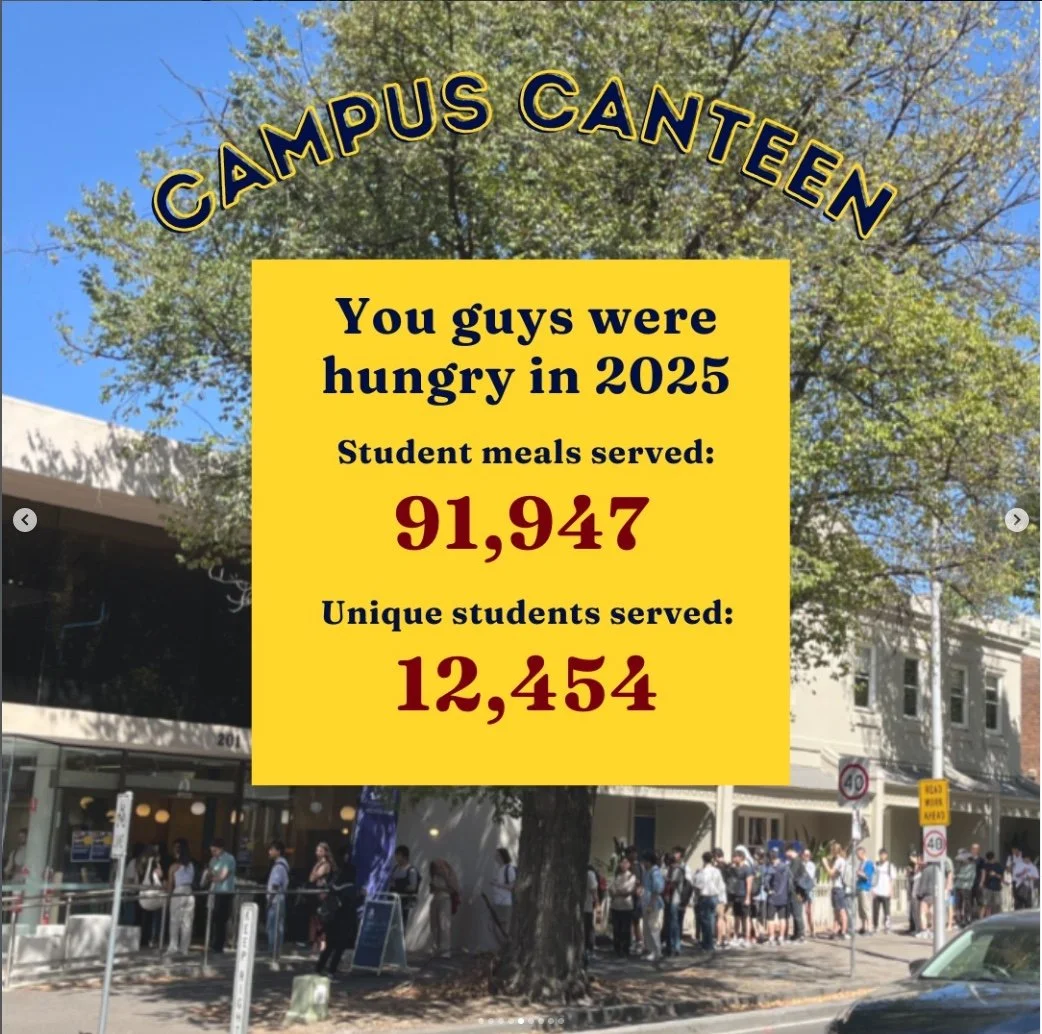
University of Melbourne’s Campus Canteen has proved to be a genuine solution for students dealing with ongoing food security.
Source: Instagram @uom.campus.canteen
Across 2025, the Campus Canteen served close to 92,000 meals to roughly 12,500 unique students. Set against a University of Melbourne student population of around 76,000, that means the service reached approximately 16 per cent of the student body over the course of the year. A meaningful cohort, but far from the entire market. That single statistic does more to settle the commercial debate than any amount of anecdote about queues out the door. The canteen is not becoming the default lunch option for the University of Melbourne's tens of thousands of students; it is meeting a concentrated, genuine need among a defined subset of them, at a scale that a well-planned precinct can absorb without collapsing the trade of everything around it.
That said, the operational strain is real and instructive in its own right. Staff have reported serving 500 to 600 meals a day at Parkville alone, with meals selling out hours before closing and queues stretching out the door. From a portfolio perspective, this points to a capacity problem rather than a market-share problem. The student queuing for a five-dollar meal because they cannot stretch to a twelve dollar one was rarely the customer sustaining the margin of the commercial café next door. The risk was never that this segment exists; sixteen per cent of a student population needing help is not a rounding error, but nor is it a takeover. The risk is failing to size the service to the need that has been proven to exist. When this isn’t considered, overflow demand either goes unmet or spills messily into adjacent retail in ways nobody has priced for.
Removing the Line Between "Subsidised" and "Everyone Else": Eat.SC
If Melbourne's canteen shows the scale of demand, the University of the Sunshine Coast's food precinct model shows how to integrate that demand without creating a visible underclass of diners. UniSC blends subsidised meal options, funded through its Student Services and Amenities Fee, directly into its main dining venue rather than routing subsidised students to a separate counter or a separate building. A student can buy a five-or-six-dollar subsidised hot meal from the same servery, in the same queue, sitting at the same tables, as a student, staff member or visitor paying full price for a burger from the adjacent outlet.
This matters more than it might first appear. Food insecurity research consistently flags stigma as one of the biggest barriers to students using the support available to them. Students describe worrying about being identified, being pitied, or being marked out as members of a separate, needier community on campus. A model that segregates subsidised diners, whether through a different queue, a different room or a different look of the food itself, quietly reinforces exactly the stigma that stops struggling students from eating.
By folding subsidy into its mainstream dining experience, UniSC has removed the seam between "subsidised" and "full price" for its students, but it's worth being precise about the model behind it. Eat.SC is run in-house by the university rather than through a leased commercial tenancy, so there is no independent retailer whose trade is directly at stake in that precinct.
What the model demonstrates is the power of integration itself: a single servery, a single queue and a single look of the food remove the stigma of segregated subsidised dining. This shows what's achievable when a university controls its own catering end-to-end. For property teams operating a mixed precinct with independent commercial tenants, the transferable lesson is not the in-house delivery structure. It is in the principle of integration: finding ways to keep subsidised and full-price customers from ever feeling visibly separated, even where a different operator holds the lease next door. That is a harder design problem than UniSC has had to solve, and it deserves its own answer.
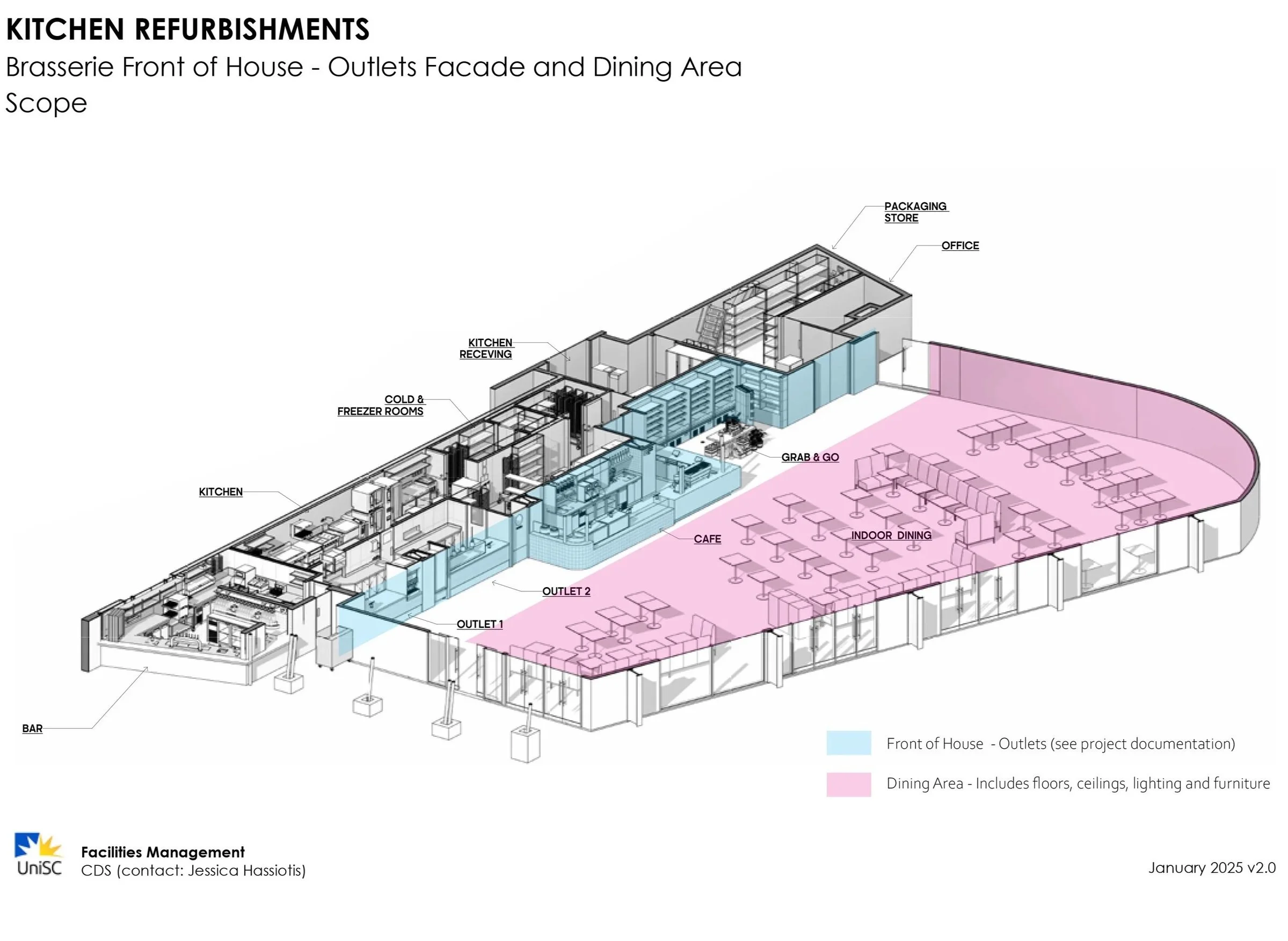
The Eat.SC dining precinct integrates a subsidised offer alongside multiple commercial concepts, all operated by a single provider. Shared seating, consistent signage and a common servery style seamlessly embed the subsidised offer within the broader dining experience, helping to remove stigma and create a more inclusive precinct.
The dark kitchen model enables the operator to utilise shared back-of-house infrastructure while delivering five distinct customer-facing concepts. This creates diversity and choice, while providing flexibility to scale, rotate and evolve concepts in response to demand.
How Subsidised and Commercial Can Share the Same Roof
The honest starting point is that a university-run canteen and an independently leased café are not the same commercial animal and the tools that work for one do not automatically transfer to the other. However, there are genuine ways to bring subsidised and full price offers into the same precinct, even the same building, without one quietly eating the other's lunch.
The first is menu differentiation, rather than price alone. A subsidised offer built around a small, fixed, rotating menu – one hot meal a day, no substitutions, no extras – is structurally different from a commercial café's à la carte range. It serves the customer who needs an affordable, filling meal and moves on; it does not compete for the customer choosing a specific coffee order, a poké bowl or a customised sandwich. The two can sit under the same roof because they are answering different questions, not the same question at two different prices.
The second is physical proximity without visual separation. Locating a subsidised counter within or immediately adjacent to a commercial food hall – sharing seating, signage style and servery aesthetics – achieves the same de-stigmatising effect UniSC has built in-house, while still allowing a commercial operator to run its own till, its own menu and its own margin on the other side of the same counter run.
The third, and the one most property teams underuse, is capping the exposure through quotas. A university does not need to offer unlimited subsidised meals to solve food insecurity; it needs to offer enough that genuine need is met without the offer becoming a default choice for the entire student population. A daily cap, such as one subsidised meal per student per day, prevents any single student from substituting all their food spend onto the subsidised menu. A weekly or termly allocation – such as ten subsidised meals per student per term – achieves the same protection while giving students more flexibility about when they use it, and gives the university a predictable, quantifiable ceiling on total subsidy exposure rather than an open-ended commitment. Either approach converts an uncapped welfare offer into a defined, costed benefit, which is exactly the language a commercial retail partner, and a university's own finance committee, needs to hear before it will support the model sitting next to its lease.
Who Delivers the Subsidy: The Case for Student Unions and Services
One design choice that gets less attention than it deserves is who actually operates the subsidised offer. Student unions and student services divisions, UMSU, USU, UniSC's Guild and their equivalents elsewhere, have been running food services on Australian campuses for generations; but the legacy version of that offer – a tired cafeteria with laminate tables and a menu that has not moved since the 1990s – is not the model that will hold its own next to a modern commercial food hall.
The University of Melbourne's Campus Canteen is instructive here too: it operates through the university's Students and Scholarly Services division, funded through the compulsory Student Services and Amenities Fee, run at a deliberate loss, with a private catering partner delivering the food. That structure, a non-profit delivery vehicle with a genuine commercial operator behind the kitchen, is a template worth taking seriously. Student unions and services are well-placed to hold the social mission, the eligibility rules, the pricing discipline and the trust of the student cohort, whilst still contracting in the presentation, food safety standards, digital ordering and service speed that students now expect from any food outlet, subsidised or not.
Universities that under-invest in this layer, that let the subsidised counter look and feel visibly second-rate next to the commercial tenancies around it, do more damage to the model than any pricing decision could. It reinforces the very stigma that integration is meant to remove; and undermines the premium positioning that commercial tenants are paying rent to be part of. If a student union or student services division is going to run the subsidised offer, it needs a genuine retail uplift budget, not just a food relief budget.
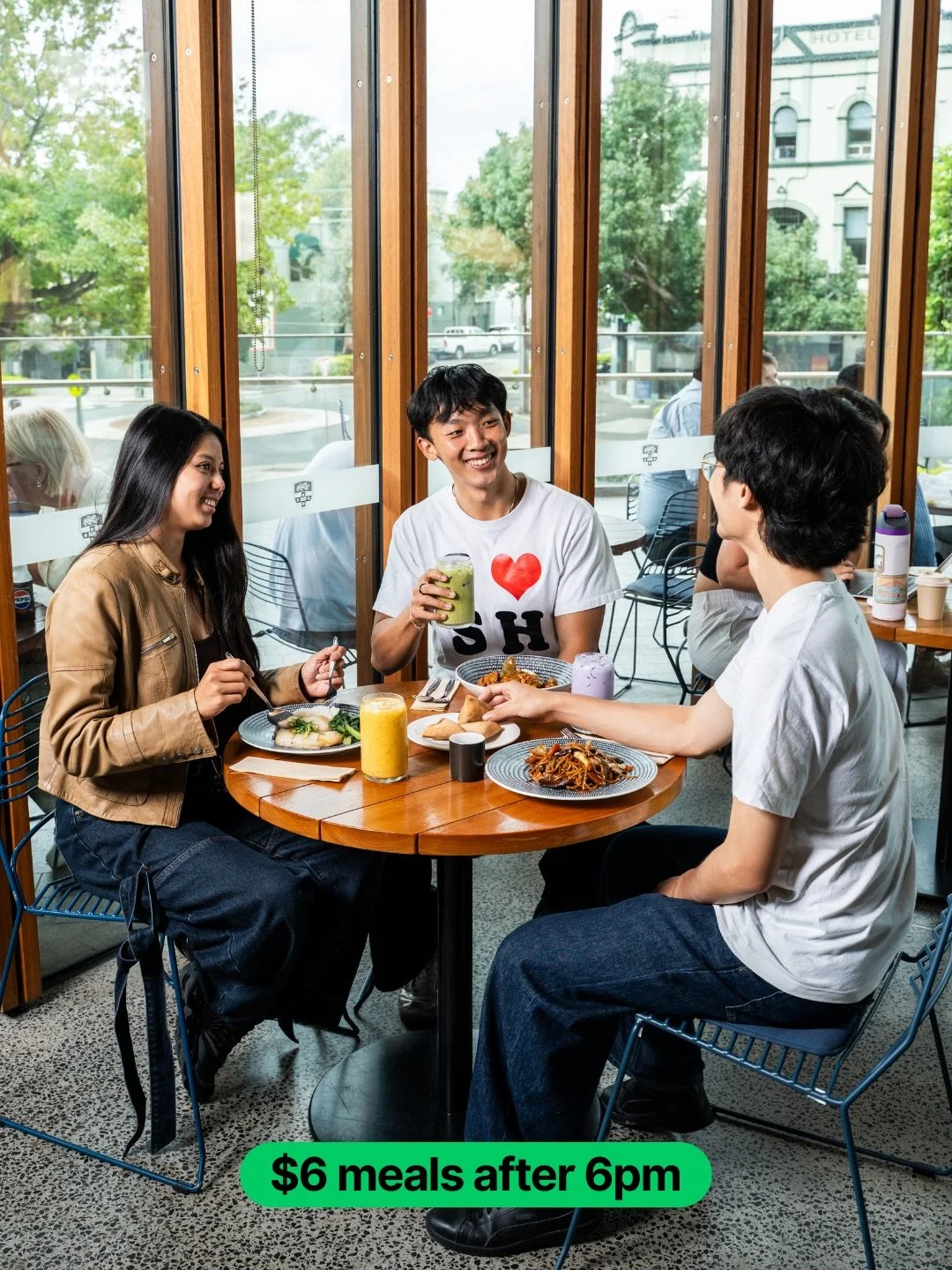
USU’s $6 after 6pm at Abercrombie. Source: Instagram @usueats
Solving for Time, Not Just Price:
USU's $6 After 6
The University of Sydney Union's approach adds a third dimension to the picture: time. Its $6 after 6 offer, running across venues including Courtyard and Abercrombie Terrace, provides a simple soup or pasta option with a complimentary drink for six dollars between 6pm and 8pm on weeknights. It is a modest menu by design, not a full replication of the daytime offering, but it exists precisely in the window when most campus food outlets have already closed their kitchens and gone home.
This is a smart use of subsidy because it targets a genuine market failure rather than competing head-on with an existing commercial offer. Few campus retailers are chasing strong margins at 7pm on a Tuesday; the economics of staying open for evening trade rarely stack up against a quiet campus, particularly at a university the size of Sydney, where more than 70,000 students are spread across a campus that empties out well before dinner. USU's model does not undercut a thriving commercial dinner trade because that trade barely exists in the first place. Instead, it captures students who are on campus late for classes, labs or library sessions and who would otherwise go without, without asking any commercial operator to compete against a subsidised price at the time of day they are actually trying to make money.
The lesson for property and retail teams planning their own precincts is that subsidy targeted at genuine gaps in time, location or occasion tends to be commercially neutral or even commercially additive, because it is not cannibalising anyone's existing trade. Subsidy layered directly on top of peak-hour, high-competition trading is a different and much riskier proposition.
“The Canteen provides a high volume of nutritious and inexpensive meals so our students can focus on their studies instead of worrying when the next meal might be.”
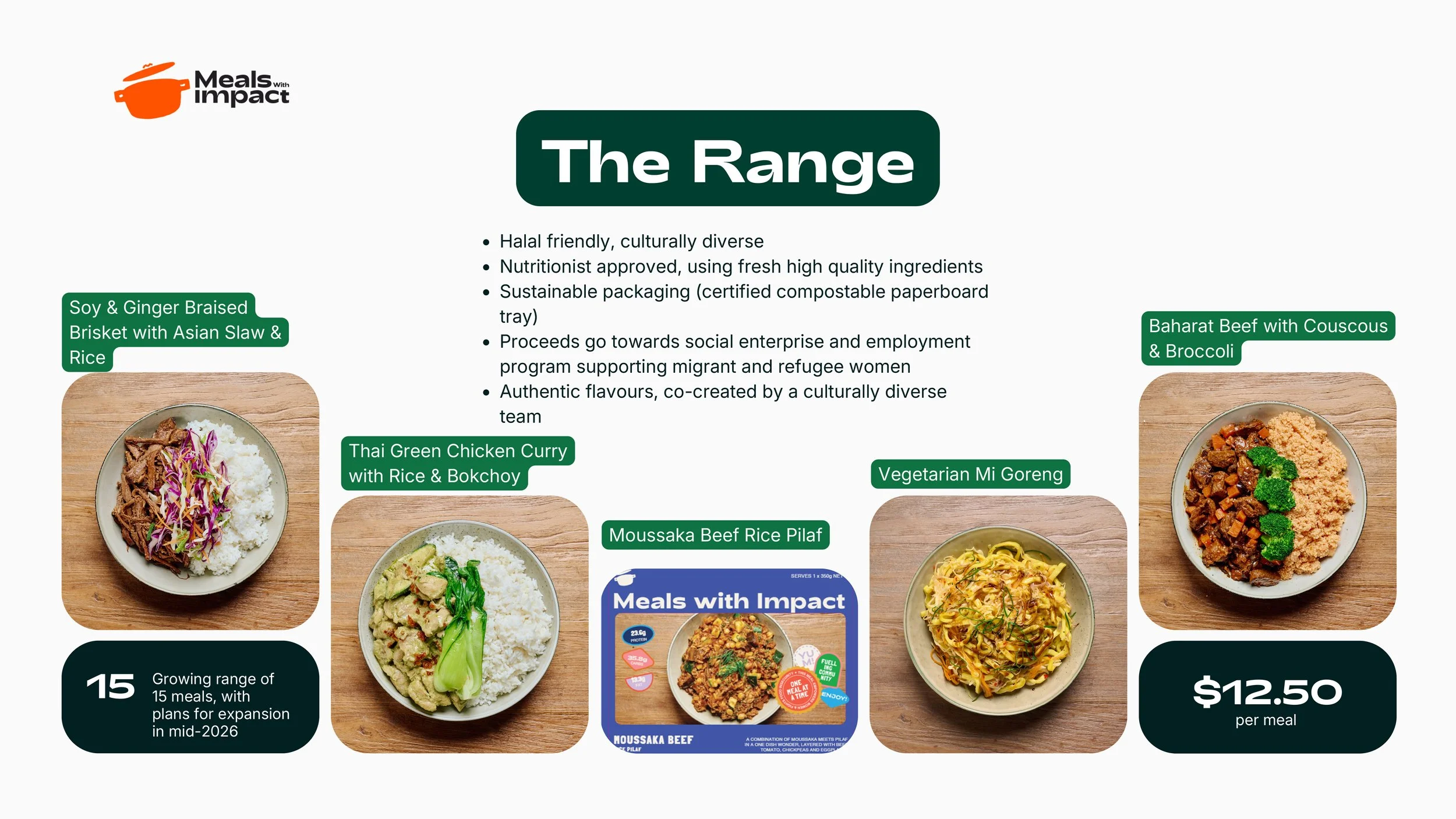
Meals with Impact, a social enterprise that provides a variety of nutritious meals of varying cuisines, with opportunity for vending and kiosk distribution to campuses that struggle to engage traditional commercial tenants.
Bringing in Purpose-Built Partners: The Case for Social Enterprise
The most interesting frontier for universities sits with organisations like Meals with Impact, a Melbourne-based social enterprise that trains and employs women from migrant and refugee backgrounds to produce culturally diverse, ready-to-eat meals. Meals with Impact has already demonstrated, through a partnership with Lendlease, how this model translates into physical infrastructure: a social impact kiosk at Melbourne Quarter in Docklands, co-designed and staffed by the enterprise's own trainees, delivering food relief and genuine cultural variety into a commercial precinct.
The vending and kiosk format is particularly well-suited to universities because it solves several problems that traditional food relief cannot. It can be activated in locations and hours that no commercial tenant would ever agree to service profitably: a satellite campus building, a 24-hour study space, a regional site with thin foot traffic. It can offer culturally specific meals that reflect the make-up of a genuinely diverse student cohort, something a standard campus food court rarely manages well. And because the social enterprise itself carries part of the subsidy through its own cost model and mission-driven pricing, the university is not solely bankrolling the discount; it is co-funding a partnership that also delivers measurable social and employment outcomes it can report against its own strategic commitments.
For a university weighing up whether another subsidy scheme will simply take share from an existing retail tenant, a social enterprise partnership placed in an under-served location sidesteps the question almost entirely. There is no commercial competitor in that location to protect, because no commercial operator was ever going to serve it.
Where the Line Actually Sits
Drawing these examples together, a genuine set of principles for the university retail strategist emerges.
Subsidy that fills a gap – in time, place or need – tends to grow the overall food economy on campus rather than shrink any one part of it. Subsidy that duplicates an existing, well-trading commercial offer at the same time and place is where the real risk to viability begins. The Melbourne Canteen's crowds, at sixteen per cent of the student population, are not descending on the campus's premium cafés at lunchtime; they are largely students who were never going to be premium café customers on that budget. USU's evening pricing does not touch a lunchtime trade that commercial operators rely on. UniSC's integrated servery shows what is possible when a university controls its own catering outright; and a well-run student union offer, differentiated by menu and capped by quota, can bring a version of that same integration into a mixed commercial precinct.
The clearest warning sign for any property team is a subsidised offer that mirrors a commercial one – same menu style, same hours, same location – at a price point commercial tenants structurally cannot match, with no cap on how much of it any one student can consume. That is the scenario in which a well-intentioned wellbeing initiative starts to function as an unfunded competitor. It is worth stress-testing every new proposal against that single question before it goes to the property committee: does this fill a gap, or does it shadow an existing lease? If it does sit close to one, what quota or design choice is stopping it from swallowing that lease's trade entirely?
The Executive Balancing Act
None of the design choices above will hold if they are made in isolation, by a property team optimising for lease income on one floor and a student services team optimising for welfare outcomes on another, with no one accountable for both at once. This is where university executive leadership earns its keep. A Vice-Chancellor and executive team that treats food strategy purely as a student experience issue will keep approving well-meaning subsidy schemes that quietly erode the commercial portfolio's performance; and eventually find retail tenants unwilling to renew. An executive team that treats it purely as a property and revenue issue will find itself, as Melbourne did, publicly under-scoped and reacting to queues out the door and headlines about hungry students.
The universities getting this right are the ones where property, student services and finance sit at the same table when a new food initiative is proposed – with shared, explicit measures of success: a target reach for the subsidised offer, a quota structure that caps exposure, an agreed tolerance for the loss the subsidy will run at; and a commercial performance benchmark for the surrounding retail tenancies that the initiative is expected to respect. That is a governance decision as much as a design one and it belongs squarely with the executive committee that signs off on both the student experience strategy and the property portfolio plan, not with either function working around the other.

A Portfolio, Not a Program
The universities managing this best are treating food relief as a portfolio decision rather than a series of individual initiatives. This requires mapping existing commercial trade by location before designing a subsidy response, so gaps are targeted rather than guessed. It means favouring integration over segregation wherever the built form allows it, following UniSC's lead where the university controls its own catering, and building genuine retail-standard delivery through student unions and services where it does not. It means using time-shifted or location-shifted subsidy models, in the mould of $6 after 6pm, ahead of blanket discounting that touches every hour of trade. It means capping exposure through sensible daily, weekly or termly quotas so a subsidised offer serves the sixteen per cent who genuinely need it without drifting into becoming the default choice for everyone. And it means actively seeking out social enterprise partners for the locations and hours that will never attract a commercial tenant on ordinary lease terms, because that is where the case for a Meals with Impact-style kiosk is strongest and the competitive risk is lowest.
None of this requires universities to choose between their students and their retail partners. It requires them to be precise about where genuine need sits, honest about where commercial trade really happens; and creative about the space in between, with an executive team willing to own the trade-offs rather than leave them to whichever team gets to the budget first.
Getting the Balance Right, Campus by Campus
What Melbourne, UniSC and Sydney all point to, in their different ways, is that food insecurity and commercial viability are not opposing forces on a university campus. They are two outcomes that a well-governed precinct strategy can deliver at the same time, provided the university is precise about where genuine need sits, honest about where commercial trade actually happens, and disciplined about the design choices – menu differentiation, integration, quotas, timing and delivery model – that keep the two from colliding.
No two campuses will land on exactly the same mix. A CBD campus with a dense commercial food precinct will lean harder on quotas and menu differentiation to protect its retail tenants. A regional or satellite campus with thinner commercial trade will lean harder on social enterprise partnerships and student union delivery, because there is little existing trade to protect in the first place. What should not vary is the discipline behind the decision: a clear read on the scale of need, a design response sized to match it; and an executive team willing to own the trade-offs rather than leave them to whichever function gets to the budget first.
At Future Food, this is the work we find most rewarding: not choosing between social purpose and commercial performance on campus, but designing precincts – and the governance behind them – precisely enough that both can succeed at once.
FURTHER READING
University of Melbourne Social Equity Institute: Talking hunger: understanding food security on campus
University of Sydney: New Student Canteen