Supercharge Your F&B Strategy...
…And Transform Your Club's Food & Hospitality Success!
Delivering a modern dining precinct in a club environment demands a future-focused strategy that runs deeper than an interior design plan and the project manager’s brief. The strategy for any well-considered project should shape the food and hospitality experience for the future of food in your Club. The F&B strategy should overlap seamlessly through the design phase, and into pre and post-opening activation of the dining precinct, ultimately welcoming customers to exciting new experiences – a benchmark in your region.
Varied, dynamic F&B offerings should deliver a range of dining experiences designed to appeal to more people, more often. Clubs must stay alert to evolving customer preferences and trends, the day of the ‘never-changing menu’ is thankfully, over!
Modern clubs should provide a diverse range of casual and premium dining options tailored to their audiences, along with evolving menus, innovative cuisines, and dining formats that meet specific consumer preferences. A well-balanced mix of F&B concepts will foster a broader audience and a greater market share – driving revenue growth and a profitable F&B department.


All images credit Ben Calvert | Vikings Group
Our work with Vikings Club (above) in Canberra across six locations devised a diversified F&B strategy for their dining venues to drive spend and visitation frequency from existing customers while expanding market share into new customers segments. The F&B strategy capitalised on Vikings’ strong points of difference (PODs) and gaps in the marketplace informed by a baseline operational performance review, cost control recommendations and a competitive trade area assessment.
Future Food’s experience working with clubs over the past 5–10 years has identified eight key factors that enable clubs to deliver exceptional hospitality offerings. These factors allow Clubs to operate successfully without relying on gaming revenue, instead attracting new customers, increasing spending, and enhancing retention.
Successful Food & Hospitality
Value: Irrespective of price point, customers expect to see a level of quality and experience that justifies their decision to spend in your venue. If your Club is being chosen on the merit of cheap meal prices alone, it is time to rethink your approach.
Points of Difference: Stand out from the pack, deliver on a vision and delight your customers.
Engagement: Provide staff with the tools and capability to deliver on customer expectations and the Club’s vision – everyday.
Profitability: Generating revenue is essential for independently successful F&B departments, but achieving true profitability requires a strategic approach that optimises the retained share of that revenue.
Consistency: Deliver on the promise. Whether its Monday morning or Friday night there is something for everyone, all day, every day.
Trends: F&B teams need to recognise and adapt menus to absorb trends. Empower the team to understand that food is fashion and the modern customer is exposed to a wide range of experiences in a media driven landscape.
Unique F&B Concepts: Create a reason to dine in your Club.
Competition: Become the benchmark in your region with an in-depth understanding of the competitive landscape. Knowledge is power!
An adaptive F&B strategy has never been more important with the last five years demonstrating that what was conceived in a strategy, designed and built over a 3-4 year period may no longer be relevant.
For clubs seeking to add value and remain affordable for their target market, Future Food’s tracking of average spend per head (ASPH) supports continued development. Between 2021 and 2023/4, ASPH steadily increased across most dining categories, largely driven by rising prices in line with inflationary pressures. However, as the cost-of-living crisis deepened, consumer spending patterns shifted.
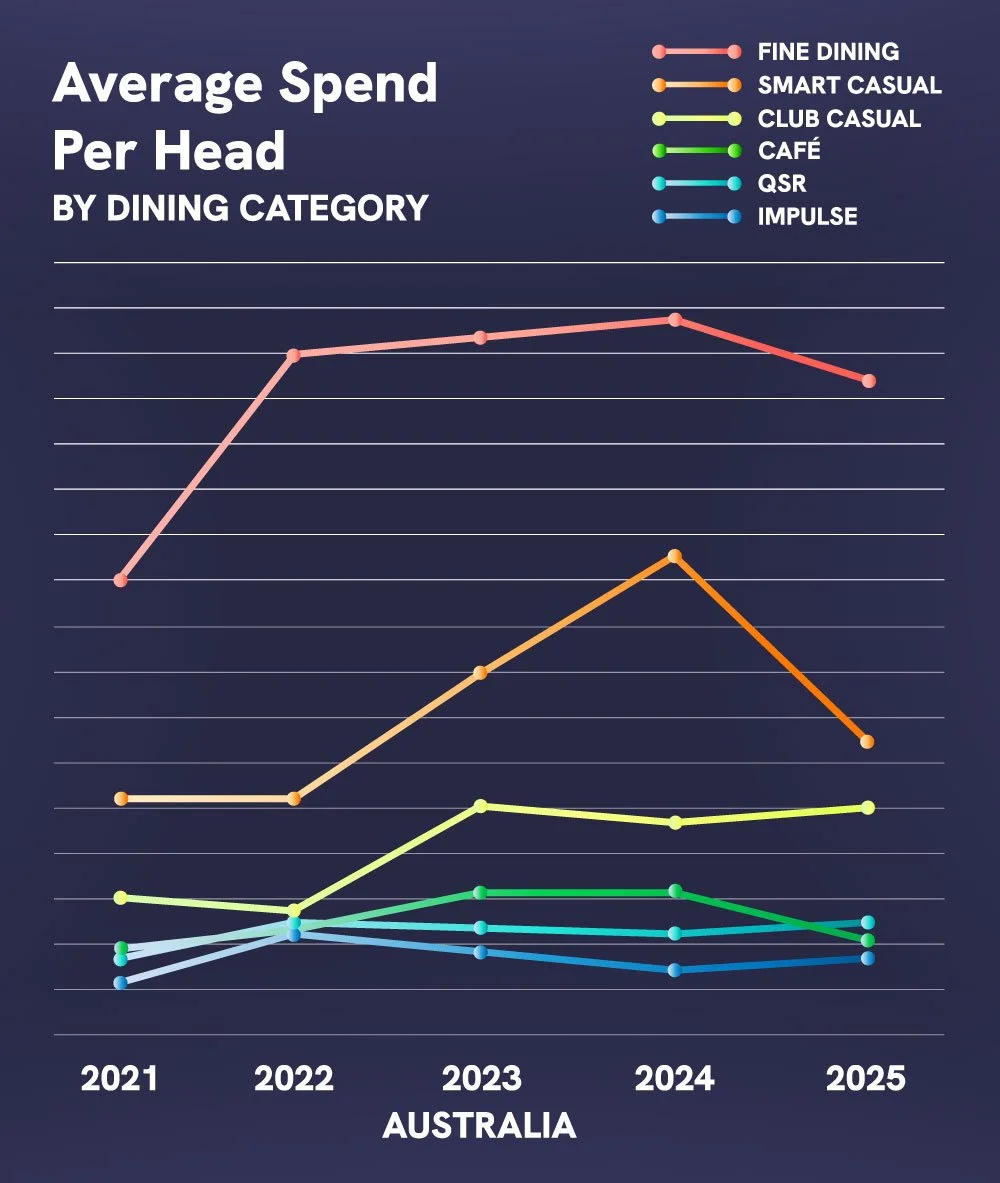
ASPH by dining category across Australia 2021-2025.
Fine dining and particularly smart casual dining have shown signs of decline in ASPH. In contrast, impulse, café, and casual dining are recovering and now reflect positive growth. Quick Service Restaurants (QSR) have seen a decline in average spend per head as they offer new price point-driven value bundles, but this has been offset by a significant increase in overall frequency of spend.
An adaptive F&B strategy enhances your ability to create a thriving dining precinct. By integrating customer-driven research, competitive market insights, and tailored F&B concepts, you build a strong foundation for a precinct that meets evolving demands. With a strategic framework guiding the design, your dining precinct is positioned for long-term success and relevance.
Speak to Future Food
and redefine the future of food in your venue.

“Future Food’s expertise in developing a tailored food and beverage strategy for Vikings Group has been instrumental in our success. Their innovative approach and deep understanding of our membership and community needs have significantly enhanced our catering services across multiple locations.
Future Food’s recommendations have not only aligned perfectly with our strategic goals but have also driven tangible results. We’ve experienced notable growth in our catering outlets and have consistently met our projected profit targets since implementing their strategies. Their comprehensive procurement review was particularly impactful, leveraging group buying power and centralising activities to optimise efficiency and cost-effectiveness. This initiative has streamlined our operations and enhanced our overall profitability.
Future Food has proven to be a valuable partner, dedicated to delivering exceptional service and results. Their commitment to understanding our unique requirements and delivering tailored solutions has made a significant difference in our business. I highly recommend Future Food to any organisation seeking to elevate their food and beverage offerings and drive sustainable growth.”
— Ron Kent, General Manager, Vikings Group